Palomar for direct tie. Trilene for snaps. Why a snap-swivel matters with hand-painted spoons. The knot mistake that loses fish at the boat.
1. Use a snap-swivel — always
A hand-painted spoon spins on the troll. Tied directly to your main line, that spin twists the line into curls within an hour and weakens it within a day. A ball-bearing snap-swivel (size 10 for kokanee, size 7 for chinook) takes the spin so your line stays straight. It also lets you swap colors in 4 seconds without re-tying.
- Kokanee + trout: size 10 ball-bearing snap-swivel (cross-lock or Coastlock snap)
- Chinook + lake trout: size 7-5 ball-bearing snap-swivel
- Avoid Duo-Lock snaps — they pop open under bigger fish
2. The Palomar knot — main line to swivel
Strongest knot you can tie with cold hands at 5 AM. Tested at 95-100% line strength. The trick is wetting the line before you cinch it down.
- Double 6 inches of line and pass the loop through the swivel eye
- Tie a loose overhand knot with the doubled line — do not tighten yet
- Pass the swivel through the loop you just made
- Wet the knot with saliva, then pull both tag and main line evenly to cinch
- Trim the tag to 1/8" — no longer
3. Leader to spoon — Trilene knot or improved clinch
Your dodger-to-spoon leader (typically 12-30 inches of 10-20lb fluorocarbon) gets tied to the spoon's split ring or built-in eye. Trilene knot for fluorocarbon, improved clinch for mono. Both pass through the eye TWICE — that doubled wrap is what stops fluoro from cutting itself under load.
- Pass tag end through the eye twice — leaves a small loop at the eye
- Wrap tag 5 times around the standing line
- Pass tag back through both eye loops (not the wraps)
- Wet, cinch, trim
4. The mistake that loses fish at the net
Nine of ten lost-at-the-boat kokanee come from a leader-to-spoon knot that slipped 20% but didn't fail — until the head-shake at the net. Two protections: re-tie the spoon every 4 hours of fishing OR after any big fish. And inspect the knot every time you re-charge the glow finish (you're holding the spoon anyway).
5. Pre-tied stinger setups
For kokanee specifically, a stinger hook trailing 1-1.5 inches behind the rear split ring catches short-strikers. Tie it to a 4-inch piece of 8lb fluorocarbon, loop it through the split ring with the spoon, and let the loose hook ride past the spoon's tail. Half-throat hookups become net hookups.
“A bad knot at the swivel loses more fish than a bad hookset.”
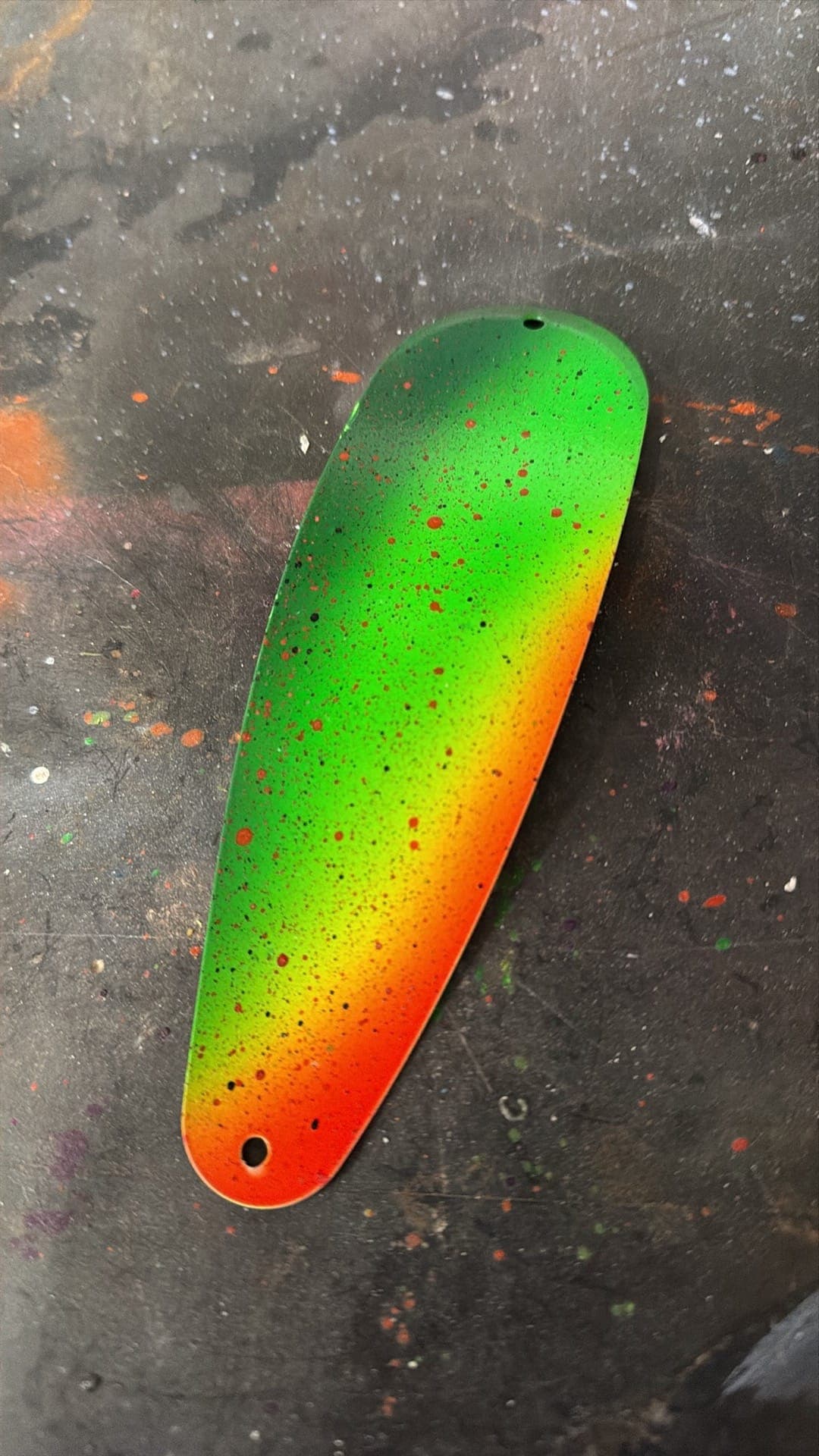
Stampede Glow
Hand-painted glow spoon tested by Brent Kowalski on Stampede Reservoir, CA. Built for kokanee, rainbow trout.